
Five Meta Ad Patterns to Study Before Your Next Brief
Study five creative patterns in Meta ads, then turn observations into original test briefs. Includes a swipe-file template and a copyable analysis prompt.

A competitor's ad can give you a creative hypothesis. It cannot tell you that the advertiser is profitable or that the same execution will work for your offer.
Use Meta's Ad Library to study how ads make an argument, then build your own version around facts you can support. The five patterns below are creative structures to look for, with fictional examples to show how to use them.
Start with observation, not a winner label
Meta describes the Ad Library as a place to find active ads across its technologies. See Meta's overview. An ad being active or long-running does not give you its commercial purchase results.
Record the advertiser, library link, date checked, visible format, opening message, offer and destination. Add a separate column for what you infer. “The product appears in the first frame” is an observation. “This must have a low CPA” is an unsupported conclusion.
Pattern 1: Show the product doing one job
Instead of describing everything, demonstrate one recognizable task. For a template, that might mean adding a project and finding the next action.
Fictional execution: A short recording shows a weekly planner turning an unorganized project list into three priorities. The copy says what the template includes, without claiming that the buyer will save a specific number of hours.
Use a real product recording. If the interface is a concept illustration, label it and avoid presenting unavailable functionality as part of the product.
Pattern 2: Put a specific frustration on screen
Start with a situation the buyer recognizes, then connect it to one supported feature.
Fictional execution: “Three client projects. Which one needs your attention first?” The next frame shows a priority field in the planner.
The frustration creates relevance. The product evidence carries the argument. Avoid adding a dramatic outcome that the feature cannot reasonably support.
Pattern 3: Show what arrives after purchase
Reduce uncertainty by showing the actual files, layout or first task. This is especially useful when a digital product can sound more capable than it is.
Fictional execution: Display the template's project list, weekly priorities and review checklist. State that it is a download and that reminders are manual.
A buyer should understand the product's form before opening checkout. A beautiful lifestyle image cannot answer what is inside the ZIP.
Pattern 4: Answer one important objection
Choose an objection you can resolve with an accurate answer. It might concern setup, required software or whether a feature is included.
Fictional execution: “Does it send reminders?” followed by “No. It includes a checklist you review yourself.” Then show the checklist.
An honest boundary can make the offer easier to evaluate. Do not claim universal compatibility or instant setup without checking the actual product requirements.
Pattern 5: Show a clear use moment
Give the product a recognizable place in the buyer's routine.
Fictional execution: A Friday project review: list unfinished work, choose next week's priorities and close the planner. Each step uses an included section.
The angle is the moment of use. It is different from a generic feature list even when both describe the same download.
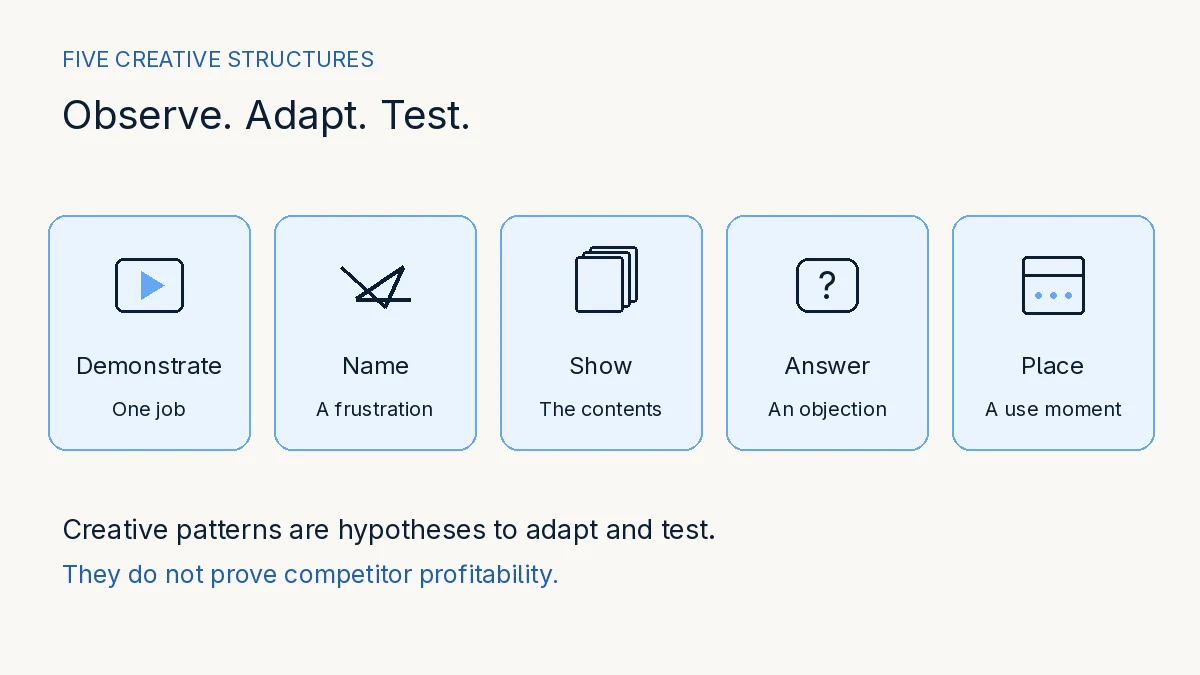
Creative patterns are hypotheses to adapt and test, not proof of competitor profitability.
The five structures are: demonstrate one job; name a specific frustration; show the contents; answer one objection; show a clear use moment.
Turn the swipe file into a production brief
Use one row per ad you inspect:
| Field | What to write |
|---|---|
| Evidence | Library URL and date observed |
| Pattern | The creative argument you see |
| Opening | Your own description of the first frame or sentence |
| Proof | What the ad visibly demonstrates |
| Unknown | Performance and other facts you cannot establish |
| Original direction | How your offer could express the pattern differently |
| Test hypothesis | What you expect the new execution to improve |
Keep your own wording, assets and product facts. Borrowing the structure does not require copying the competitor's ad.
Free pattern-analysis prompt
Analyze the ads I provide as creative examples, not proven winners.
Use only the visible copy, assets and page evidence I supply.
For each identify the hook, product argument, proof, objection and CTA.
Separate observations from inference. Do not invent spend, CPA or ROAS.
Group the examples by creative pattern.
Using my separate verified product brief, propose three original concepts
with different arguments. Do not copy the advertisers' wording or visuals.
For each concept give an asset list, supported claims and a test hypothesis.
The next step is a clear assignment: one buyer, one argument, the assets needed and the response you plan to measure.
Get the free AI Ad Creative Brief Builder to turn your offer into one draft concept, headline, copy and image brief. If you want the full creative builder alongside five other agents, see Agent 01 in the 6-agent kit. Applicable tax and AI-tool costs are separate.
For the next production step, use our Meta ads creative brief template.